


Introduction
Food businesses often need to determine the nutritional composition of their products for labeling, compliance, and customer transparency.
Two common approaches are used for this purpose:
- Recipe-based nutritional analysis
- Laboratory testing
Understanding the differences between these methods helps businesses choose the most suitable option.
What is Recipe-Based Nutritional Analysis?
Recipe-based nutritional analysis calculates the nutritional content of food using ingredient composition databases.
The method involves analyzing:
- Ingredient types
- Ingredient quantities
- Cooking methods
- Serving sizes
The nutritional values are then calculated using standard food composition data.
What is Laboratory Testing?
Laboratory testing involves physically analyzing a food sample in a laboratory to determine its nutrient composition.
This process uses chemical analysis methods to measure nutrients such as:
- Protein
- Fat
- Carbohydrates
- Vitamins
- Minerals
Key Differences
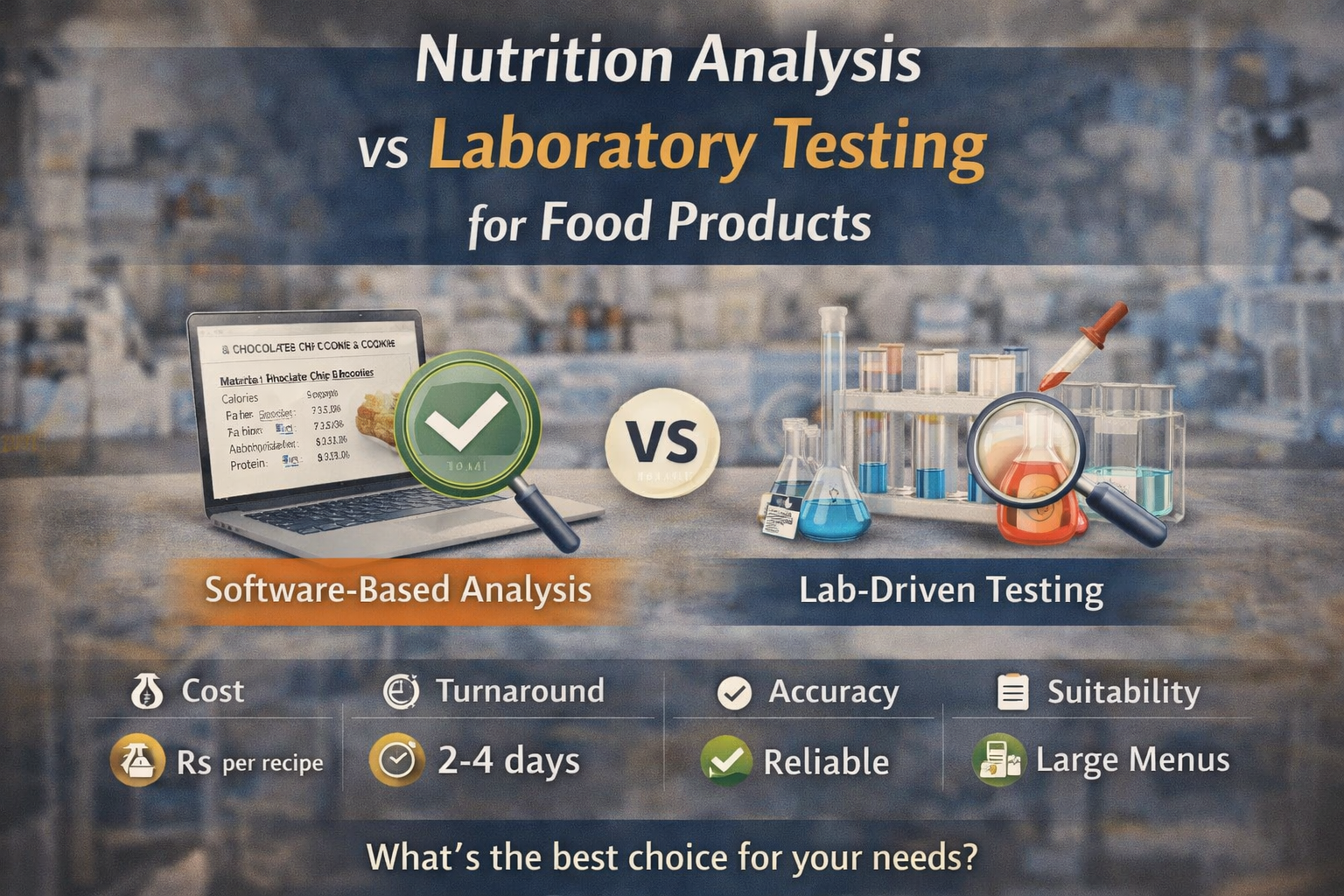
Speed
Recipe-based analysis can be completed quickly, especially when analyzing large numbers of recipes.
Laboratory testing can take several weeks per sample.
Cost
Recipe analytics is generally more cost-effective, particularly for restaurants with large menus.
Laboratory testing can be significantly more expensive when many products need analysis.
Scalability
Recipe-based analysis allows businesses to analyze hundreds or thousands of recipes efficiently.
Laboratory testing requires separate testing for each individual product.
Accuracy
Both methods can produce reliable results when performed correctly. Recipe-based analysis is widely used for menu labeling and regulatory compliance in the food service industry.
Which Method is Best for Restaurants?
For restaurants and hospitality businesses, recipe-based nutritional analysis is typically the most practical solution because menus are based on standardized recipes.
It allows restaurants to update nutritional values easily whenever recipes change.
Conclusion
Both laboratory testing and recipe analytics have their place in the food industry.
However, for restaurants and food service establishments, recipe-based nutritional analysis offers a scalable, efficient, and practical solution for menu labeling and compliance.