


Introduction
Food transparency is becoming increasingly important in India’s hospitality industry. Customers today want to know not only what they are eating but also the nutritional value of the food served to them.
To promote informed food choices and improve public health, the Food Safety and Standards Authority of India (FSSAI) has introduced regulations that require certain food businesses to display nutritional information on their menus.
These rules apply primarily to restaurant chains and large food service establishments, making menu labeling an essential compliance requirement for the modern hospitality industry.
What is Menu Labeling?
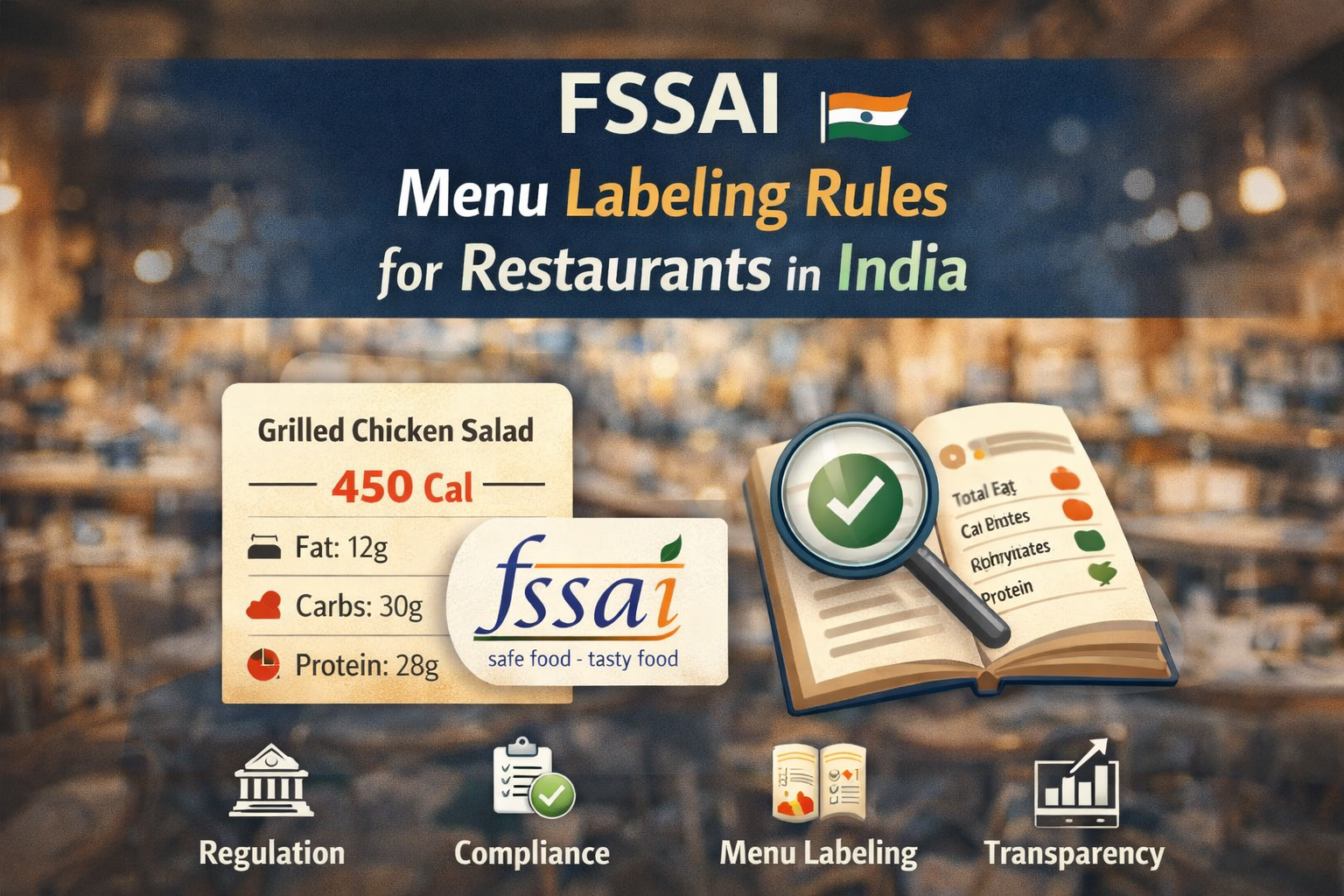
Menu labeling refers to the practice of displaying nutritional information of food items directly on restaurant menus, menu boards, or digital ordering systems.
The information typically includes:
- Energy (Calories)
- Total Fat
- Saturated Fat
- Trans Fat
- Added Sugar
- Sodium
- Serving Size
This allows customers to make healthier and more informed food choices when dining out.
FSSAI Regulations for Menu Labeling
Under the Food Safety and Standards (Labelling and Display) Regulations, certain food service establishments are required to provide nutritional information for their menu items.
The regulations were introduced as part of India’s efforts to improve nutrition awareness and food transparency.
The rules apply mainly to:
- Restaurant chains with 10 or more outlets
- Food service businesses operating in multiple locations
- Centralized kitchens supplying standardized menus
These businesses must display the nutritional information of their food items per serving.
What Information Must Be Displayed?
According to FSSAI guidelines, restaurants must display the following nutritional values per serving:
Mandatory Nutritional Information
- Energy (kcal)
- Total Fat (g)
- Saturated Fat (g)
- Trans Fat (g)
- Added Sugar (g)
- Sodium (mg)
This information should be presented in a clear and readable format on:
- Printed menus
- Digital menus
- Menu boards
- Online ordering platforms
Why Menu Labeling is Important
Benefits for Customers
- Make healthier dietary choices
- Monitor calorie intake
- Avoid excessive sodium, sugar, or fat consumption
- Compare different menu items easily
Benefits for Restaurants
- Build customer trust and transparency
- Demonstrate compliance with food safety regulations
- Improve brand credibility
- Position themselves as health-conscious and responsible food providers
How Restaurants Can Calculate Nutritional Values
To comply with menu labeling rules, restaurants must determine the nutritional composition of each menu item.
This is typically done using recipe-based nutritional analysis, which calculates the nutrient content based on:
- Ingredients used
- Quantity of each ingredient
- Cooking method
- Portion size
The process involves analyzing each recipe against standard food composition databases to generate accurate nutritional values.
Challenges Restaurants Face in Menu Labeling
Many restaurants find menu labeling challenging due to:
- Large number of recipes
- Frequent menu changes
- Complex ingredients
- Lack of technical expertise
- Need for standardized calculations
For large hospitality businesses, manual calculations can become time-consuming and prone to errors.
How Professional Nutritional Analysis Helps
Professional recipe analytics services can help restaurants comply with FSSAI requirements efficiently.
These services provide:
- Accurate recipe-level nutritional analysis
- Standardized nutrient calculations
- Bulk analysis of hundreds or thousands of recipes
- Detailed audit-ready nutrition reports
Such reports can be used during food safety inspections or compliance audits.
The Future of Food Transparency
Menu labeling is part of a broader global trend toward greater transparency in the food industry. Many countries now require restaurants to disclose calorie information and nutritional data.
In India, these regulations represent an important step toward:
- Promoting healthier eating habits
- Increasing accountability in the hospitality sector
- Encouraging responsible menu design
As awareness grows, customers are likely to expect nutritional information as a standard feature on menus.
How TouchPoint Gourmet Consultants Can Help
At TouchPoint Gourmet Consultants, we help restaurants and hospitality businesses comply with FSSAI menu labeling regulations through accurate recipe nutritional analysis.
Our services include:
- Nutritional analysis for restaurant menus
- Bulk recipe analytics for large food chains
- Audit-ready nutrition reports
- Menu labeling support for regulatory compliance
With the ability to analyze thousands of recipes efficiently, we help food businesses across India implement transparent and compliant menu labeling systems.
Conclusion
FSSAI menu labeling rules represent an important step toward building a more transparent and health-conscious food industry in India.
Restaurants that adopt nutritional labeling not only meet regulatory requirements but also demonstrate their commitment to customer health and responsible food practices.
As the hospitality industry evolves, data-driven recipe analytics and nutritional transparency will become increasingly essential.